After This Our Exile
Director Patrick Tam has made some kind of a comeback. Prior to After This Our Exile, Tam had directed eight films, his last being My Heart is that Eternal Rose in 1989. He moved on to become a successful editor for such notable directors as Wong Kar Wai (Days of Being Wild, Ashes of Time) and Johnnie To (Election).
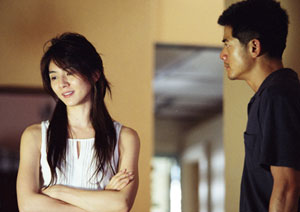
The story of his new film is about a dysfunctional Chinese family living in Malaysia. During the opening scenes of the film, Lin (Charlie Young) attempts to leave her husband, Shing (Aaron Kwok), and their son, Lok-Yun (Goum Ian Iskandar) in search of a more fulfilling life, away from her inattentive husband. However, Lok-Yun finds out and tells his father who then stops her from leaving. This is the start of an infernal spiral. Finding out about her plan for escape, Shing hits Lin and locks her in their bedroom. The couple quarrel and after awhile the husband, finally noticing his lack of promise as a husband, tries awkwardly to work things out his own way. One day, Lin finally leaves the family whilst the husband and child were away on a cruise. The life of the child gets worse as the father is soon unemployed. With loan sharks pursue them, they are forced to leave their house, bringing out the theme of exile. Shing, unable to find a job, begins to laze around with a prostitute, getting drunk and forcing his son to steal for them until Shing gets beat up by the owner of the house. This is without mentioning that the son was also beaten up by his father several times throughout the film without much of any significant reason besides trying to make him talk! Soon, Lok-Yun is caught stealing and is arrested by the police while Shing runs away, abandoning his son. When Shing comes to visit him in prison, he gets bitten by the ear by an enraged Lok-Yun, finally completing the process of his family’s disintegration as well as the destruction of his son’s innocence. Finally, ten years later, the son is out of prison and seeks to return what he had stolen to their owner, possibly to remove himself from his own past and start anew. He then looks for his father and discovers that he has remarried with a pregnant wife.
Surprisingly, this film has met with considerable acclaim and success: it won Best Feature Film, Best Actor and Best Supporting Actor awards at the 43 rd Golden Horse Awards and also won the award for Best Artistic Contribution at the 19 th Tokyo Film Festival. When a selective film viewer sees the promotional material, he or she might think that this is a good movie. However, I beg you, dear readers, to not to act like a bunch of sheep. It feels like the praise given by the industry to Tam’s new film is mostly because of the industry’s high regard for the director’s previous work, even if his new film is not good. However, even if the festival and award jurors believe this film to be that good, we must not forget the quality of work that has been done this past year in Asia. According to me, Exiled, directed by Johnnie To, was a true masterpiece compared to this film. But before I begin to heap an entire mountain of rocks at this film, let’s take a deeper look at After This Our Exile, shall we…
Firstly, the story. After This Our Exile can be classified as a family drama, or rather a melodrama, in which we see the struggles of the each individual members of the dysfunctional family. Sometimes, these kinds of films can contain significant shifts in character perspectives (also called omniscient narration) allowing the spectator to understand the story from different character’s point-of-view which is a technique used in this film. In the case of drama, an omniscient narration can also convey a common theme experienced by different characters: in The Joy Luck Club (Wayne Wang, 1993), the omniscient narration shows the struggle of Chinese women and their daughters. However, in After This Our Exile, there is no purpose of using either an omniscient narration or common theme. The parents’ perspectives are not interesting and embody all the clichés about uncaring and irresponsible parents that you could possibly have. Their stories are not touching as well because of their extreme portrayals, no giving us any room to sympathize with them.
Patrick Tam & Kai-Leong Tian, the scriptwriters, should have also given substantial time to each character so as to allow us to understand and sympathize with the characters in their story. Overall, the character of the mother has probably 20 to 25 minutes of screen time while an hour is spent on the father and the rest is dedicated to the son. Already, in terms of timing, the separate narratives are given unequal time and ultimately contributes to the failure of the film. Finally, a basic rule of drama that should be fulfilled by the filmmakers – who the audience sympathizes with. In this film, it’s not the uncaring mother who left everybody behind, nor is it the father who is deep in debt, gambles and lies to his child about him finding a job. The audience is supposed to be sympathizing with the child. It was unwise of the writers to spend so much time on the selfish father or the uncaring mother when we do not really understand their motives and their psychological backgrounds when the story was supposed to be told from the child’s point of view!
I must also remark on the actual Chinese title of the film, which literally translates as Father and Son. This title suggests that the film is about a relationship between father and son. But the story was told from multiple points-of-view, including the mother’s. Once again, the son’s perspective would have worked better for the spectator.
An omniscient narration can also help to bring out some secrets to the audiences. For example, in the film we discover that the reason the Lin leaves Shing and Lok-Yun is not only because of her husband’s inadequacies, but also because she has a lover. However, some details that are revealed to us are not coherent with the rest of the story. Lin mentions to her lover that she cares for her son, yet she never tries to find out about how her son is doing and neither does she try to return to her former home and bring him back with her.
These are only a few of the problems in the script. However, the direction of Patrick Tam is even more absurd. I do not understand how film festival judges and programmers can be so blind! His direction for the actors consists of basically overacting their emotions in order to make sure that even the guy talking on his cell phone in the audience gets what is going on. We are not watching television when, possibly, members of the family are distracted by several things happening in the house. We are watching a film in a theatre on a huge screen and we do not need actors who cry their eyes out for god’s sakes! When an audience laughs at such a scene, it is perhaps because the line of absurdity has been crossed.
The film also uses domestic violence as the main form of communication between the characters. The film starts with the wife being beaten by her husband, then the child gets beaten by his father just when he asked a simple question. Furthermore, the father gets beaten up by the loan shark, and then the son bites his father… In the end, it makes me think about the story Woody Allen’s character narrates when under hypnosis in his film, Zelig: “My brother beat me; my sister beat my brother; my father beat my brother, my sister and me; my mother beat my father, my sister, me and my brother; the neighbors beat our family; people down the block beat the neighbors and our family... ” The film just becomes ridiculous!
Finally, a bit about technicalities. Let’s start with the editing and the use of music. At the climax, we can hear a piano theme that reaches its crowning moment at the end. However, it is not because we hear a frenetic piano theme that the public is automatically moved by the emotion portrayed on the screen. After some thinking, it is very similar to the pattern of being beat up. The repetition and the intensity almost transformed the soundtrack into an absurd motif! Or perhaps the director took to the meaning of melodrama a bit too literally and applied it to his film. He tries to move his audience using drama and music, thinking that adding music over scenes of violence and sadness scenes would create the desired effect. Once again, the laughter it generates from the audience demonstrates that melodrama is not to be taken literally.
Patrick Tam also uses very strange angles to shoot the film. For some scenes in the family’s house, the director uses low-angle shots thought there isn’t any purpose to use such shots when all the rest of the shots were at normal eye-level. The ending is probably the catharsis of errors and it is surprising that such a renowned editor can purposely make so many continuity errors! The grown-up son stands near the river and we see a series of inter-cut blue-shaded images. The images depict tracking shots of a tree and a river mixed in with some frenetic high-pitch piano notes. This sequence then turns into a series of jump-cuts as it is edited with a couple of reverse shots of the son, this time in orange hues, observing his father from the other side of the river. Finally, the sequence shows a few flashback images of occurrences that took place earlier in the film, making us think that we are in front of a really bad melodrama that looks like the films made in the eighties. We can almost assume that Patrick Tam hasn’t evolved as a director since then. I believe that the contemporary audience is more sophisticated than this, but what I do not understand is how festival jury members can acknowledge such bad work with awards! Even an amateur cinematographer and editor would pay more attention to the lack of continuity and rhythm in this sequence, not to mention that student films are sometimes better. Overall, we can at least mention that the film is consistent in its absurdity.
During the film, two of my best students and I watched this film hoping that, at some point, both the story and filmmaking will get better. The final scene was the pinnacle of its disappointments. We burst into laughter, unable to withhold our hysteria. How can such a bad film have the opportunity to be shot on 35mm? How, with such a bad script, could it have been financed in the first place?
There are directors out there for which we hope would have a long and successful filmmaking career while there are others who should just retire and open up a coffee shop. This is also true for film festival programmers and members of the festival jury. For a film to win Best Feature Film and Best Artistic Contribution, the film has to be truly outstanding. Maybe they just think that the audience is a bunch of fools and they get what they deserve for recognizing a film’s awards and merits. Well, it is time that we show them otherwise! After this, our exile from the movie theatre!
Written by: Melanie Morrissette |